Eight questions. No fluff. This is the thinking behind BASE - in Chad's words, in the order it actually makes sense. If you want to understand the methodology before you read the book, start here.
What gap did you see that made you think there has to be a better framework?
I wouldn't say other approaches are wrong - but I believe BASE is the most efficient path to lasting results.
Here's what I kept seeing, in businesses and in my own experience: something goes sideways, and the immediate reaction is what action do we take to fix it? Jump to the fix. Patch the result. And sometimes you have to - the methodology allows for that. But that's not where the real work is.
The real work is in the foundation underneath.
If you spend time understanding what you actually value - not what you say you value, what you demonstrate - and you understand your stakeholders and what they need, and you get clear on what you're trying to accomplish as a culture... now you have something to build on.
And here’s where it gets powerful: when the people inside an organization can line up their personal BASE to what the organization is trying to accomplish — when they can see that working here actually serves their own life, their own goals — that creates synergy. Real synergy, not the corporate buzzword version. The company creates conditions where alignment is natural, not forced.
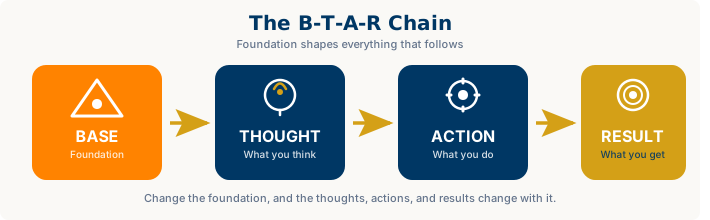
The chain is always running. Foundation → Thought → Action → Result.
When that happens, it changes the way people think. Not in some systematic, almost cult-like way - it does it naturally, in a way that lines up with who people actually are. Decisions come quicker. They feel more natural. Results change - not because someone mandated a new process, but because the foundation shifted.
And when you've identified your desired outcome from the beginning, and you can evaluate along the way - do we need to adjust the filter? Is new data telling us something? Is the industry moving? - you're not reacting anymore. You're steering.
How did BASE actually start for you - was there a moment where the framework clicked, or did it build over time?
It built over time - a long quest, really.
It started with a simple question: how do people and systems work most effectively? My early work experience and an interest in behavioral science had me trying to understand how people behave, how they work, and how results are actually formed. That question pulled me deeper.
I got especially intrigued by concepts like mental models and paradigms - but I wanted to go further. I didn't just want to name the filter. I wanted to understand what makes up the filter. What are the components? And more importantly - can they be managed? Can they be shaped?
As I kept digging, I started to see themes emerging across everything I was reading and experiencing - hints that pointed in a consistent direction, even if the behavioral science itself didn't fully ground them in one place. Over time, I was able to arrive at three fundamental things that form a subconscious filter we all use.
Once I had that, the shape of the triangle came naturally. And I realized something important: triangles have weak points - at the corners. As I started to evaluate the three sides and understand that they weren't fixed, that they had to move and adapt, the gaps earned their names.
And once I started making sense of it - once I could apply it - I watched my own results improve almost automatically. Not because I was working harder. Because the foundation had shifted.
The triangle has three sides - Knowledge, Values, and Self-Concept. For someone hearing that for the first time, how would you explain what they are and why they matter?
There's a lot that lives inside each side, but the definitions themselves are actually pretty succinct.
Knowledge is what the word tells you - the things we know. But it goes much deeper than surface-level expertise. Part of what we need to know, as an individual or a group, is: who are the stakeholders we serve? Internal, external, all of them. What are their needs and expectations? And those needs and expectations aren't static - they shift. When they shift, it affects the gaps.
But knowledge also includes things like: what's happening in our industry? What trends are shaping where things are headed? What does the competitive landscape look like? At the organizational level - what's our vision? Where are we trying to go, and do we actually understand the terrain between here and there? At the personal level - what's my vision for my own life? What do I need to learn, develop, or understand to get there? Knowledge isn't just what you know today. It's your awareness of what you need to know - and whether you're keeping up with a world that's constantly moving.
Values is where it gets personal. What are the things we actually value? And it has to start at the personal level. Not the values taped to the wall - the ones we demonstrate. What is our outward being showing? Do we like what it's showing, or do we need to adapt? And then, as we work together in groups and teams and organizations, how do those individual values merge into something shared?
Self-Concept is how we see ourselves - and it's not fixed. At the personal level, self-concept shifts with the situation. How do I feel about myself in this meeting? With this stakeholder? Taking on this new responsibility? Confidence rises and falls, and that affects how we process everything through the filter.
At the organizational level, self-concept becomes culture. It's the collective version of the same thing - how does this organization see itself? Not the mission statement on the website, but the lived reality. Are we confident in who we are? Do we know what we're good at and where we're growing? Just like an individual, an organization's culture isn't static. It shifts with new challenges, new people, new markets.
And that's where the gaps become powerful. The distance between where self-concept is today and where it needs to be isn't a flaw - it's the growth opportunity. The gaps are where we learn.
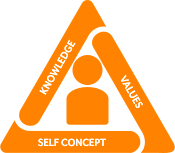
The individual BASE triangle - three sides, three gaps, one foundation.
You talk about gaps in the triangle. What are the gaps, and why are they where the real work happens?
When the three sides came together visually as a triangle, something clicked. The triangle is the strongest shape there is - that felt right for a foundation. But the strongest shape still has weak points, and in every triangle, those weak points are the corners. That's where the sides meet. That's where things can break.
So I started researching: as these three sides come together, what happens at the intersections? What lives in those gaps?
The Accountability Gap sits where Knowledge meets Self-Concept - or at the organizational level, where Knowledge meets Culture. This is the gap that asks: do you actually know your stakeholders? All of them? Do you understand the industry, the vision, where the road is going? On a personal level, it's the same question - do you know where you're headed? When this gap is weak, people and organizations drift without direction. When it's strong - when we write principles and follow rules that keep accountability tight - it strengthens both Knowledge and Self-Concept at the same time. A culture with strong accountability knows where it's going and believes it can get there.
The Character Gap lives at the bottom of the triangle, where Self-Concept meets Values - or where Culture meets Values. This is where it breaks down when people act outside of their values, or don't understand what their values are, or don't hold values at all. Stakeholders feel this one immediately. When they interact with you - individually or as a company - and they don't see those values show up in the real world, trust erodes. But when we write principles and follow rules in that corner, when character is strong, it reinforces both who we are and what we stand for.
The Discipline Gap sits at the top, where Knowledge and Values intersect. This is where we learn and grow. Where we learn from our mistakes and take corrective action. The principles here focus on: how do we grow our knowledge? How do we grow in our values? And what we learn in that discipline gap flows right back down both sides of the triangle - feeding new stakeholder understanding, new expectations, new industry awareness down through the accountability gap, and reinforcing what we value and how we demonstrate it down through the character gap.
The gaps aren't flaws in the triangle. They're the pressure points where the real work happens. Strengthen them with principles, and the entire foundation gets stronger.
If you have high character and high accountability, your self-concept - or your culture - is strong and thriving. And if discipline is working at the top, you're constantly feeding growth into both sides.
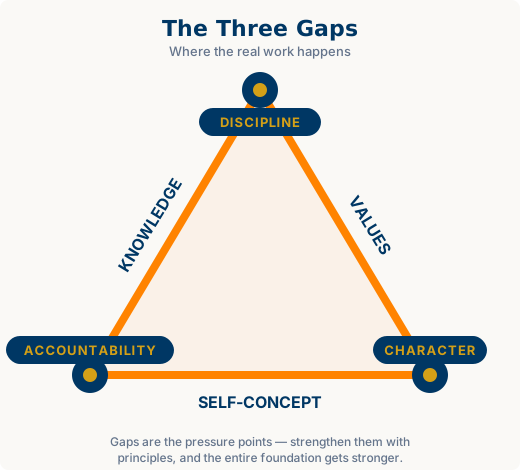
The three gaps - where the sides meet, where the real work happens.
You say "ego vs. reality" is at the heart of self-concept. What do you mean by that, and why does it matter so much?
Self-concept is where this gets personal. And when there's two or more people, self-concept becomes culture - same idea, just collective. But let's start with the individual.
Self-concept is really a mix of three things: self-image, self-esteem, and self-determination. How I see myself, how I feel about myself, and how much I believe I control my own path. And those shift situationally - in some situations we're more confident, in others less. But as a whole, self-concept is the picture you carry of who you are.
What I love to talk about is the simple definition: ego plus reality equals self-concept.
Ego gets a bad reputation. People hear "ego" and think arrogance. But ego is just what you bring to the table - your confidence, what you know, what you believe about yourself. You have to bring that. Without it, you're not showing up.
But at the same time, you have to check that ego with reality. Reality is what your results are showing you. What other people think. What the data is telling you. You have to be open to that too.
Here's where it breaks down: if you live on ego alone - if you only listen to your own confidence and never check it against what's actually happening - eventually, you're going to have a problem. But the opposite is just as dangerous. If you live on reality alone, if you only listen to what other people think and let external feedback drive everything, you'll lose yourself. You'll stop leading and start reacting.
You need both. Bring the ego. Bring the reality. Self-concept is what you get when they come together honestly.
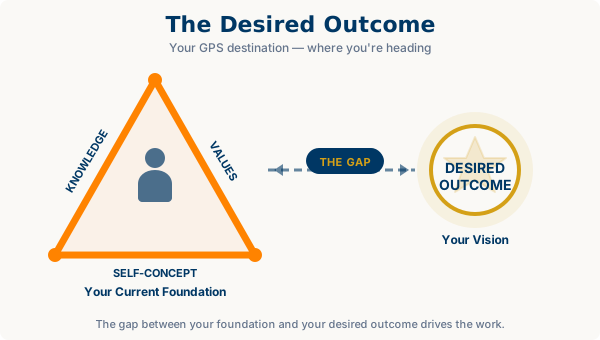
Self-concept is the picture you carry. The Desired Outcome is what it drives toward.
How does BASE scale from one person to an organization? What changes and what stays the same?
The individual BASE is where it all starts. And it's so important that we don't rush through it - even though we want to. We're pre-programmed, especially in organizations, to jump straight to strategy and action. Get to the results. But the more we understand the personal BASE, the stronger everything else becomes.
What does that mean in practice? It means being intentional about understanding who you are as a person. What values do you bring? What stakeholders do you know, and what do you really know about them - their needs, their expectations? Once you understand those things, you use the gaps to strengthen your self-concept. That's the individual work, and it matters.
How it scales to an organization is really a conceptual leap - but it's a natural one. If we can analyze my values and your values, we're going to find similarities. If we map the stakeholders I know and the stakeholders you know, and we understand their expectations, we can combine those pictures. Now we're building something shared.
From there, the gaps do the same work - just at scale. In the accountability gap, we write principles around knowing who all of our stakeholders are, understanding their expectations, and how we're going to exceed them. In the character gap, we define how we're going to live by our shared values. In the discipline gap, we commit to how we're going to learn and grow together.
And as that expands - two people, then a team, then an organization - the framework holds. The triangle is the same shape. The gaps are the same gaps. What changes is that the principles get broader, the stakeholder map gets bigger, and the desired outcome becomes something we visualize and pursue together.
I believe the book and the portal help people bring that leap together faster. The methodology gives the structure. The tools help you see your BASE alongside someone else's and find where they connect.
→
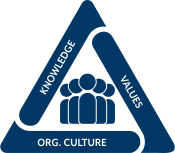
Same triangle. Same gaps. Individual to organizational - the framework scales.
What's the difference between someone who reads about BASE and someone who actually lives it? What does it look like when it's working?
This is an interesting question because I see it play out a lot. When I talk with people about BASE, it clicks fast. It's relatable. It's common sense. Almost everyone gets it.
But the people who actually dive in - they're not necessarily the ones who understand it better. They're the ones who want to do the work. They see things in their life, in their work, in their organization that they want to improve, and they're willing to slow down long enough to build the foundation.
Now, they still want to get to their destination fast. They want strategy. They want actions. And that's okay - the methodology actually leans into that, because we can work it backwards and forwards. You can start from your desired outcome and trace back to the foundation, or you can build the foundation up and watch the outcomes shift. Both paths work.
But the people who truly lean in - who take the time to understand who they are, where they want to be, and start to open their eyes to how it all connects - that's when something changes. They start to see how people and systems can work together almost effortlessly. When individual BASEs align, when the gaps are being managed, when the principles are lived and not just written down - it stops feeling like a framework you're applying. It just becomes how you operate.
That's when the magic happens. And once someone sees it working, they don't go back.
What do you want people to walk away with - whether they read the book, visit this site, or work with you directly?
I want people to feel connected to it. I want them to see the simplicity.
So much of what I've put together in BASE is common sense - and the reason for that is it's how our brain already works. All I'm doing is drawing a tangible way for us to see it. A simplified, tangible way to interact with our own foundation. And once we can do that, everything shifts.
Here's what it looks like: you know where you're trying to go. You can see it. You plug it into your GPS - your desired outcome - and you understand the three gaps. As long as you follow your principles, as long as you stay true to exceeding stakeholder expectations - and remember, you are one of your own stakeholders - as long as you're living your values, learning and growing in both your values and your knowledge, and staying laser focused on the knowledge that's connected to that desired outcome... you're going to get there.
And then you're going to get there again. And again.
Success in your life doesn't have to feel like a grind. When the foundation is right, results start to feel almost automatic. Not by accident. By design.
Go Deeper
Ready to look at your own foundation?
Get the BASE Framework Overview - a free introduction to the methodology - plus early access to tools, insights, and updates on the book.
Get the Framework Overview